Plainer words throughout, and the notes on where each fact comes from are in the "Sources" lines.
The family tree and charts now say "not yet proven" for links that still need an original record.
Earlier updates (5)
October 30, 2026 (evening): Two or more generations further back on every line
New section, Further back: every family line taken two or more generations further, with the history of each family and 17 original records.
Proven: Polly Webb's parents John Webb and Nancy Hall, and her grandfather Martin Hall, an 1807 Emory River settler; Polly Jones's grandparents Garrett Hall, a War of 1812 captain and Morgan County's first sheriff, and Telitha Davidson; Alta Clark's grandparents; the Patchings back to 1760s Sussex, England; Stella Waddell's parents and grandparents in Ohio and Kentucky.
Surprise: Zachary Scott and Polly Jones were very likely third cousins, through two Hall brothers who married two sisters.
Corrections: Russell Scott's wife was called "Polly", not "Nancy"; John Webb died in 1841; George Patching was born in Worthing; his father was a baker; Garrett Hall served in the War of 1812, not the Revolution.
The family tree grew from 50 to 106 people.
Correction the same evening: Maria Wakeford's parents (Thomas Wakeford and Lucy Luer) changed from proven to very likely. Their daughter Maria's 1811 baptism is proven; that she is the Maria who married James Patching is a strong match, not yet proven.
October 30, 2026: Gary is the older brother, and a changelog
Gary is Nancy's older brother (the family confirmed it). The family tree and Gary's card now show that.
Added to "What's still unknown": the family story of John Long Scott being hit by a trackside mail crane. No newspaper story has been found yet.
This changelog is new. From now on every change to this page is listed here, newest first, with the date.
October 26, 2026: Corrections across the site
102 statements were corrected or given a label such as "likely" or "the family remembers".
Fixed: the 1950 census gives the Patchings' home on Highway 27, not where the store was.
New records: Russell and Margaret's 1947 engagement notice, and a 1960 newspaper letter from Alta about John's stroke about 1950.
October 25, 2026: Interactive family tree
New: an interactive family tree of 50 people across the Scott, Clark, Jones, Webb, Long, Patching, Waddell and Smithers families. Tap anyone to move the tree to them.
Each generation card has a "Show in the family tree" button.
October 16, 2026: The site goes live
First version: a 15-stop map of everywhere the Scotts lived, from Maryland in 1755 to Stewarts Ferry Pike, the land from the air from 1951 to today, the house Gary built, the Scott line, and the records.
9914 Stewarts Ferry Pike, Lebanon, Tennessee
The Scott House on Stewarts Ferry Pike
Built by Gary Scott in 1997, on a wooded knoll near Gladeville. And the long road the Scotts took to get there.
The house as photographed for the October 2023 listing, with a flag at the front steps. 2023 listing photo (RealTracs MLS).
The story in brief
From at least 1951 until the house was built, this was a wooded knoll about a mile east of Gladeville, with farm fields below it toward Sinking Creek.
In 1988 the land was divided into lots. Gary Scott built the two-story house on Lot 8 in 1997, and he and Gloria owned it until 2024.
Gary's Scott line runs back through Chattanooga, Knoxville and Lancing, the Huffman farm and Sunbright, Montgomery on the Emory River, Kentucky, North Carolina and Maryland.
Its oldest proven member, Thomas Scott, fought at the Battle of Kings Mountain in 1780. His sworn statement for his Revolutionary War pension still survives.
Everywhere the Scotts lived
Scroll to follow the family from Maryland in 1755 to the house Gary built. Solid pins are proven places; dashed pins are close but approximate.
1 of 15
1
Maryland (probably Prince George's County)
Thomas Scott born July 19, 1755
Who: Thomas Scott Likely
Thomas swore in 1833 that he was "born in Maryland not certain in what County." Copies of old Maryland land records, made by a Scott family historian, put his parents, Samuel Scott, a millwright, and Mary Jones, in Prince George's County (briefly Anne Arundel). His grandfather Thomas was registered at birth in 1702 in Queen Anne Parish, near today's Leeland.
The same copies place the family's own tracts, with names like "The Girls Portion" and "William and Mary Increased," on branches of the Anacostia River, west of here; they have not been mapped. The pin marks Queen Anne Parish.
St. Barnabas Church, Leeland, the old church of Queen Anne Parish, Prince George's County, Maryland, photographed April 20, 1937. John O. Brostrup, Historic American Buildings Survey, Library of Congress.Queen Anne Parish around Leeland on an 1899 map. Copies of the old deeds, made by a Scott family historian, put the family's own land farther west, on branches of the Anacostia River; they have not been mapped. USGS Patuxent sheet, 1899.
2
Wilkes and Burke counties, North Carolina
about 1770 to 1808
Who: Thomas Scott and Lettice Russell; Samuel Scott born here in 1777 Proven by records
From Maryland, Thomas was "carried to North Carolina Wilkes County." In 1777 he volunteered for a tour "against the Indians" on the frontier and was stationed at Fort Crider, at today's Lenoir. He married Lettice Russell in 1775 in what became Burke County, according to their son Samuel, and Samuel was born there on June 19, 1777.
In the fall of 1780 Thomas rode with the mounted militia to Kings Mountain, "was in said Battle," and stayed to care for the wounded. He said the family lived in Burke County until about 1808; a fellow soldier said Iredell County, and the family's land claims were on the Lower Little River, where Burke, Wilkes and Iredell met (now Alexander County). In 1793 he bought 290 acres on Randolph's Creek of the Lower Little River in Wilkes County. The pin marks Morganton, the county's courthouse town.
Burke County, N.C.: Fort Crider at Lenoir, Silver Creek and the Catawba River, the ground Thomas Scott served over in 1777-78. USGS Morganton sheet, 1905.Thomas Scott's sworn 1833 statement for his Revolutionary War pension: born July 19, 1755 in Maryland; at the Battle of Kings Mountain. Pension file W5997, transcribed by Will Graves, revwarapps.org.
3
Spring Creek, near Albany, Kentucky
after 1800 to 1821
Who: Samuel and Lydia (Long) Scott; Russell born here in 1808 Family story
Samuel and Lydia farmed "about three miles from Albany, on Spring Creek," with a mill on the creek and a cave where they made saltpeter, the main ingredient of gunpowder. Their sons Russell (1808) and Julian (1810) were born here.
A Samuel Scott, almost certainly him, served in 1813 as 3d sergeant in Captain William Wood's company of Kentucky mounted volunteers, and the family remembered him coming home "having epaulets on his shoulders."
"My father owned a farm and lived about three miles from Albany, on Spring Creek. He had a mill on the creek. He owned a cave from which they made saltpeter."Russell Scott, 1895, as written down by his son Zachary
Albany, Spring Creek and the Kentucky-Tennessee line. Blue marks roughly where Spring Creek runs "about three miles from Albany," near where the family says Samuel had his farm and mill (exact site unknown). USGS Byrdstown sheet, 1929.1813: "Samuel Scott, 3d Sergeant," Captain William Wood's company, Colonel Taul's Kentucky mounted volunteers. Kentucky Adjutant General, Soldiers of the War of 1812 (1891), via Internet Archive.
4
On the Kentucky-Tennessee line
about 1808 to 1837
Who: Thomas and Lettice Scott in their old age Proven by records
Thomas lived his last 25 years "at the State Line between Kentucky and Tennessee." He was too frail to reach his own county court, so in 1833 he crossed into Fentress County, Tennessee, to give his sworn statement for his pension. He died on March 1, 1834, and Lettice in early 1837.
1837: Samuel Scott, a justice of the peace, certifies that his parents married in 1775 in what became Burke County, and that he was born there June 19, 1777. Pension file W5997, transcribed by Will Graves, revwarapps.org.An 1839 map of the country between the Albany (Paoli) area of Kentucky and Montgomery, Tennessee. The family says they made this move in 1821. David Burr map, 1839, Library of Congress.
5
Montgomery, on the Emory River
from 1821 (family account; on record from 1824)
Who: Samuel and Lydia Scott and their children Proven by records
In 1821, the family says, they moved to Morgan County, Tennessee, and settled on the Emory River at the spot that became Montgomery. Samuel built "a large double house" and a mill. He bought the land around the future town in 1824, and in 1825 he was named one of seven commissioners who chose the site for the new county seat, laid out in 1826.
He was a justice of the peace, a local judge, and kept one of the town's taverns, "Ye Olde Tavern," on the Nashville-Knoxville road. The Scotts owned enslaved people who did the tavern's work. Samuel died in 1841 and is buried under a stone gravehouse, a little stone house built over the grave, in the Montgomery Cemetery above the river. The tavern was lived in until about World War I and is now gone.
"Ye Olde Tavern" at Montgomery, the log inn Samuel Scott kept until 1841, photographed while it was still lived in, probably by about World War I (date unknown). Old postcard as printed in the Morgan County News, 1960, via TNGenWeb.Montgomery on the Emory River, about a mile from Wartburg. Red: Samuel Scott's grave. Blue: the approximate site of the town of Montgomery, county seat 1826-1870. USGS Camp Austin quadrangle, 1935.Montgomery on "Emery's River," Morgan County, on an 1832 map of Tennessee. Matthew Rhea map, 1832, Library of Congress.The Morgan County history on Samuel Scott, Montgomery and the tavern. Dickinson, Morgan County (1987), p. 12.
6
Up the Emory, near Gobey
1840s to 1850s
Who: Russell and Mary "Polly" (Webb) Scott and their children Family story
Samuel also took up a large tract "about two miles up the river." Family papers say Russell's daughter Rhoda was born on Scott land there in 1845, that his wife Mary was buried in the nearby Elizabeth Cemetery (unmarked) in 1854, and that the lumber town of Gobey later grew up on the W. J. Scott place. Zachary, though, said he was born near Sunbright in 1849, so the family may have moved.
Up the Emory from Montgomery: Gobey, built on the W. J. Scott place according to the family, and the Elizabeth Cemetery, where the family says Mary Webb Scott was buried in 1854 (her grave is unmarked). USGS Gobey quadrangle, 1935.
7
Sunbright
1849 to 1901
Who: Russell Scott in his last years; Zachary Taylor Scott; John Long Scott born 1882 Proven by records
Zachary Taylor Scott was born near Sunbright in 1849 and married there in 1871. His son John Long Scott was born at Sunbright in 1882. Russell Scott died near Sunbright in 1896 and is buried in the Hall Cemetery east of town. Sunbright itself grew up around the railroad about 1880, so "near Sunbright" is how the family later described the place. The exact homestead hasn't been found.
Sunbright and the Hall Cemetery, where Russell Scott (1808-1896) is buried. USGS Pilot Mountain quadrangle, 1935.
8
The farm at Huffman Switch
1901 (family record) to about 1925
Who: Zachary and Mary Scott until the late 1920s; John and Alta Scott and their children Likely
The family website says Zachary bought a 55-acre farm at Huffman in 1901. Huffman was a whistle stop on the railroad two miles north of Sunbright. John and Alta raised their family there with him. The family's descriptions (a small valley crossed by the railroad fill, a quarter to half a mile from the switch) best fit the valley of a stream the government calls Scott Branch. That is likely, not proven; the 1901 deed would settle it.
Alta moved the family to Lancing in the middle of the 1924-25 school year, about January 1925, after the Huffman school closed early one winter. Zachary's verdict: they had "got too fine to live in the country." By 1975 only the chimney stones were left.
"Our place was located in a small valley. The railroad fill crossed the valley, separating our farm from our neighbors. ... I always enjoyed seeing the train crossing the fill."Jewell Scott Voss, journal, 1942
Huffman Switch and the little valley of Scott Branch, where the railroad fill crosses. Going by the family's descriptions, this is probably the area of the Scott farm (about 1901-1925). USGS Rugby quadrangle, 1952.Zachary Taylor Scott and his wife Mary "Polly" in front of their home (filed with the family's Huffman photos). Scott-Clark(e) Family Association collection.All that was left of the Huffman farmhouse in 1975: the chimney stones. Scott-Clark(e) Family Association collection.The five oldest children at Huffman: Dorothy, Jewell and Caroline in back, Johnny and Bill in front. Scott-Clark(e) Family Association collection.Russell (Gary's father) and Bill on a rock near the black walnut tree at Huffman, about 1922. Scott-Clark(e) Family Association collection.The one-room Huffman School, about 1919, with Dorothy and Jewell Scott. Scott-Clark(e) Family Association collection.
9
Lancing
about 1925 to 1961
Who: John and Alta Scott; Russell grows up here Likely
In Lancing the family first lived in the Hixon House beside the tracks, then the "Hood" house, and from the 1930s in a frame house close to the Lancing Presbyterian Church; family photos show the church behind their yard. Jewell's journal and letters place John at work at the Lancing depot. Russell grew up here, played football at Central High in Wartburg, and wrote home here all through the war.
The 1950 census found John and Alta's household at Lancing. About 1950 John had a stroke; in 1960 Alta wrote to a Knoxville newspaper columnist that her husband was "a semi-invalid from a stroke about 10 years ago." John died in 1961; Alta was photographed at the Lancing house that May.
"...there is a little village known as Lancing. It happens to be my home town. The houses, mostly of white-painted frame construction, nestle in the cup formed by surrounding ridges..."Dorothy Scott, "The Hills of East Tennessee," 1951
Lancing in 1952, with the approximate area of John and Alta Scott's house (from family photos) near the Presbyterian church. USGS Lancing quadrangle, 1952."Grandpa Scott," John Long Scott, at Lancing in the 1950s. Scott-Clark(e) Family Association collection.The Scott family at Lancing in the 1950s. Scott-Clark(e) Family Association collection.Russell Scott behind the Lancing house (probably 1930s). Scott-Clark(e) Family Association collection. (small negative scan)The church minister's house at Lancing, near the Scott house, with Bill Scott shoveling snow. Scott-Clark(e) Family Association collection. (small negative scan)Waiting on the train at Lancing. Scott-Clark(e) Family Association collection. (small negative scan)Alta Scott at the Lancing house, May 1961. Scott-Clark(e) Family Association collection. (small negative scan)February 13, 1960: Mrs. J. L. Scott of Lancing writes to the "Strolling" columnist: "My husband is a semi-invalid from a stroke about 10 years ago." Knoxville News-Sentinel, February 13, 1960, p. 12, via Newspapers.com.
10
Oakdale
1920s to 1951
Who: Margaret Grey Patching grows up the grocer's daughter Proven by records
A few miles down the line, Margaret Patching was born in Oakdale in 1923. Her father Walter ran the Walter Patching grocery in Oakdale from the 1920s until 1951. In April 1950 the census lists him, at 59, as a retail grocery merchant in his own business, and gives the family's home as Highway 27, just outside Oakdale town (probably today's Old Harriman Highway). Where the store stood is not recorded.
The Walter Patching grocery store in Oakdale, run from the 1920s to 1951. Margaret grew up the grocer's daughter. Scott-Clark(e) Family Association collection.1950 census: Walter Patching, 59, retail grocery merchant in his own business. The household's street is Highway 27, just outside Oakdale town. The census does not say where the store was. 1950 U.S. Census, National Archives.
11
Cookeville
about 1946 to 1947
Who: Russell Julian Scott at Tennessee Tech Proven by records
After the war Russell went to Tennessee Tech. In January 1947 his mail came to 809 Arnold Avenue, Cookeville, a street that no longer appears on today's maps. In July 1947 a Knoxville paper announced his engagement to Margaret Grey Patching, then working for the Atomic Energy Commission at Oak Ridge, with the wedding planned for the fall at her parents' home. His brother Bill wrote accepting the invitation to be best man "at your wedding on September 26th."
January 1947: a letter to Russell at 809 Arnold Avenue, Cookeville, while he was at Tennessee Tech. Scott family wartime letters, scottclarke.org.July 31, 1947: Margaret Grey Patching's engagement to Russell J. Scott. She was with the Atomic Energy Commission at Oak Ridge; he had served four years with the Army Air Forces; the wedding would be in the fall at her parents' home. Knoxville News-Sentinel, July 31, 1947, p. 14, via Newspapers.com.Undated note, filed by the family as August 1947: brother Bill accepts the invitation to be best man "at your wedding on September 26th." Scott family letters, scottclarke.org.
12
727 Dale Avenue, Knoxville
by 1949 to 1950
Who: Russell and Margaret, newlyweds Proven by records
Russell finished his degree in transportation at the University of Tennessee. The April 1950 census found Russell, 29, and Margaret, 26, in Apartment 2 at 727 Dale Avenue, in the Fort Sanders neighborhood near campus. Their children hadn't been born yet.
April 1950 census: Russell J. Scott, 29, and Margaret P., 26, at 727 Dale Avenue, Apartment 2, Knoxville. 1950 U.S. Census, National Archives.1949: a letter from Russell at 727 Dale Avenue, Knoxville. Scott family letters, scottclarke.org.
13
Chattanooga
by 1953 to about 1980
Who: Russell and Margaret raise Nancy and Gary Proven by records
Russell made his career with the airlines, and the family lived "for many years" in Chattanooga, where Margaret was active at Brainerd United Methodist Church. Gary was the older of their two children; his sister Nancy was born there in February 1953, and they grew up there. They stayed until about 1980, when Russell retired. The pin marks the church; the house itself hasn't been found yet.
Margaret with Nancy and Gary. Scott-Clark(e) Family Association collection.Gary, Alan, Nancy, Bobby and Carole in Chattanooga. Scott-Clark(e) Family Association collection.
14
Oakdale, in retirement
about 1980 to 2013
Who: Russell and Margaret back home in Morgan County Likely
After Russell retired from United Airlines in 1980, he and Margaret came home to Morgan County. A county tax record for the rights to whatever lies under the land still lists "Scott Russell J" with a mailing address of 1121 Old Harriman Highway, outside Oakdale. At that address is a one-story house the county dates to about 1920, with a pole barn on 31 wooded acres; it sold in February 2023.
Margaret died in 2000 and Russell in 2013. They are buried side by side at Morgan Memorial Gardens in Wartburg.
Russell and Margaret's stone, Morgan Memorial Gardens, Wartburg. Find a Grave.
15
9914 Stewarts Ferry Pike
about 1993 to 2024
Who: Gary and Gloria Scott, Abigail and Arthur Proven by records
Lot 8, eight acres of woods near Gladeville, last sold still empty in October 1993, most likely to Gary and Gloria, and Gary built the house in 1997. County tax bills show them as the owners until the 2024 sale. Fifty-four years before the house went up, his father had camped in a pup tent in "the maneuver area - near Lebanon."
The house as photographed for the October 2023 listing, with a flag at the front steps. 2023 listing photo (RealTracs MLS).The 2023 drone photo, looking south, with both of Gary's lots outlined in green. Lot 8 and the house are on the right. 2023 listing photo (RealTracs MLS).
The family tree
Everyone named in the records, from Gary back to Maryland in the 1700s on the Scott side and to Sussex, England on the Patching side, with every family that married in. Tap anyone to move the tree to them, or pick a name from the list. A solid outline means records prove it; dashed means likely; dotted means a family story, or a link not yet proven. Living people show names only.
Proven by recordsLikelyFamily story, or not yet provenLiving
Swipe the tree sideways to see more of the family.
Before the house
What the ground at 9914 Stewarts Ferry Pike was before Lot 8 existed.
The house stands about a mile east of Gladeville, an old farming community named for the cedar glades around it: open, rocky patches where limestone lies at or just under the surface, ringed by red cedars. An 1879 county history called Gladeville "old enough to have grown larger, but it didn't."
1956 government survey map. Green is woods. The red circle is the house site: a wooded knoll with Sinking Creek at its foot and fields on the creek side. USGS Gladeville quadrangle, 1956.
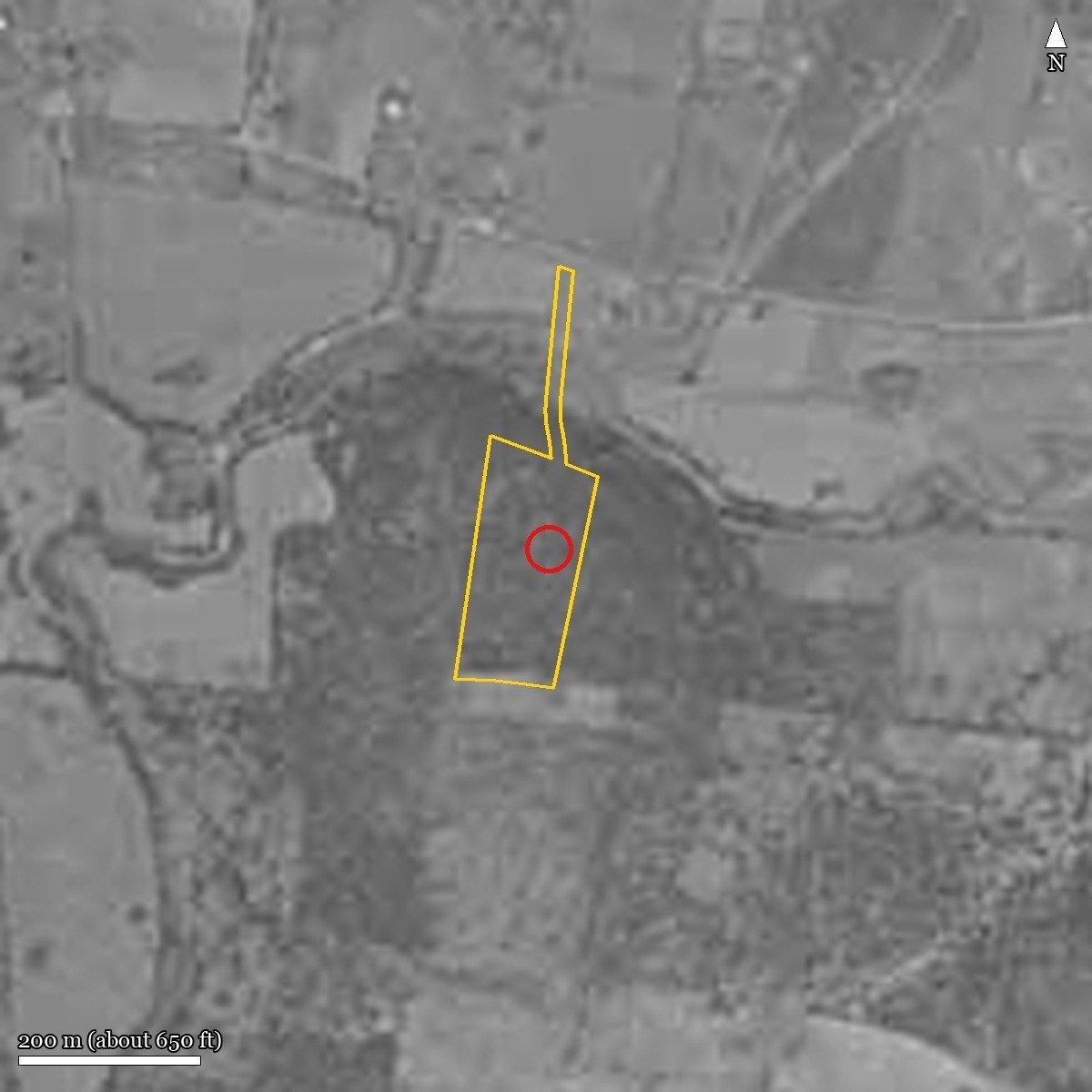
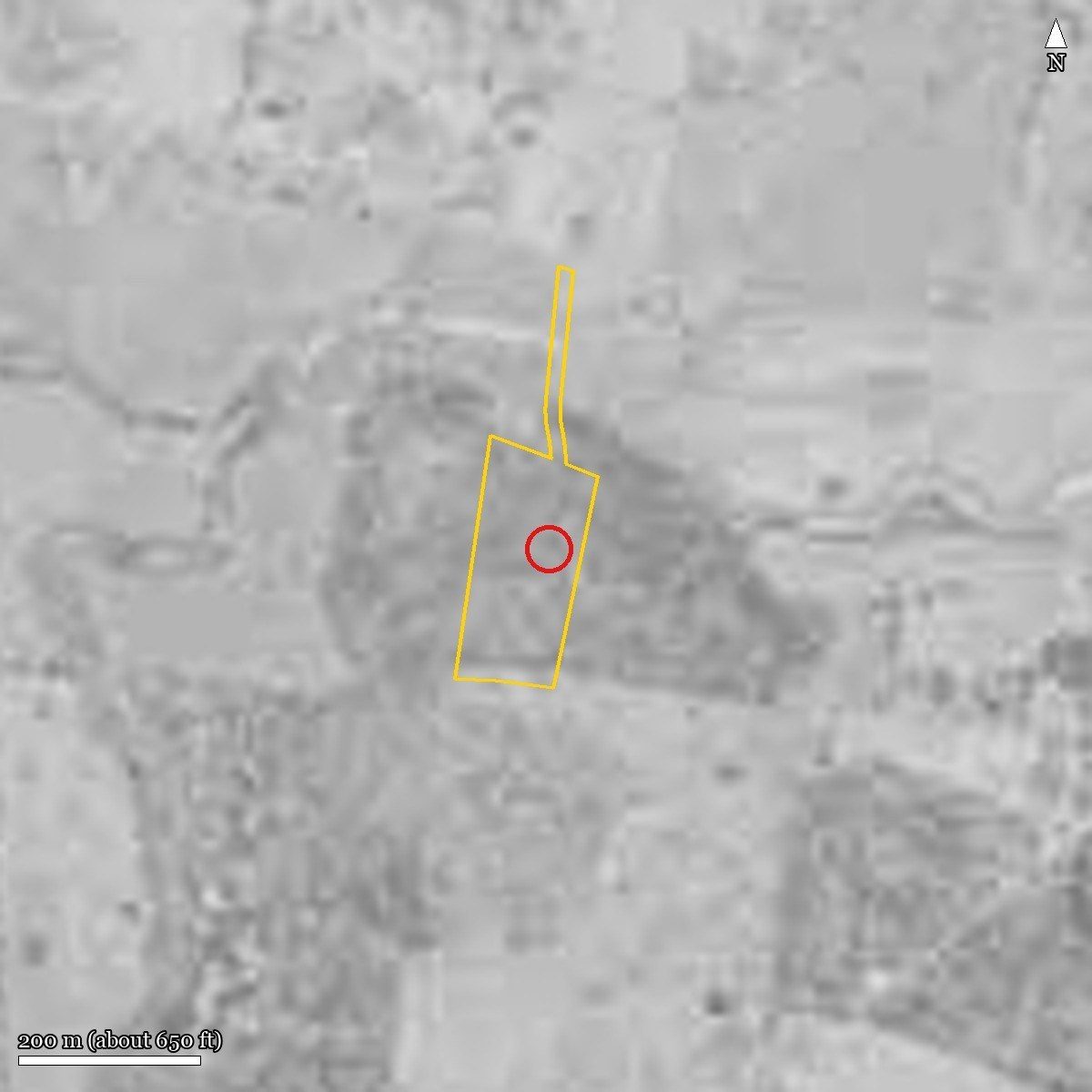
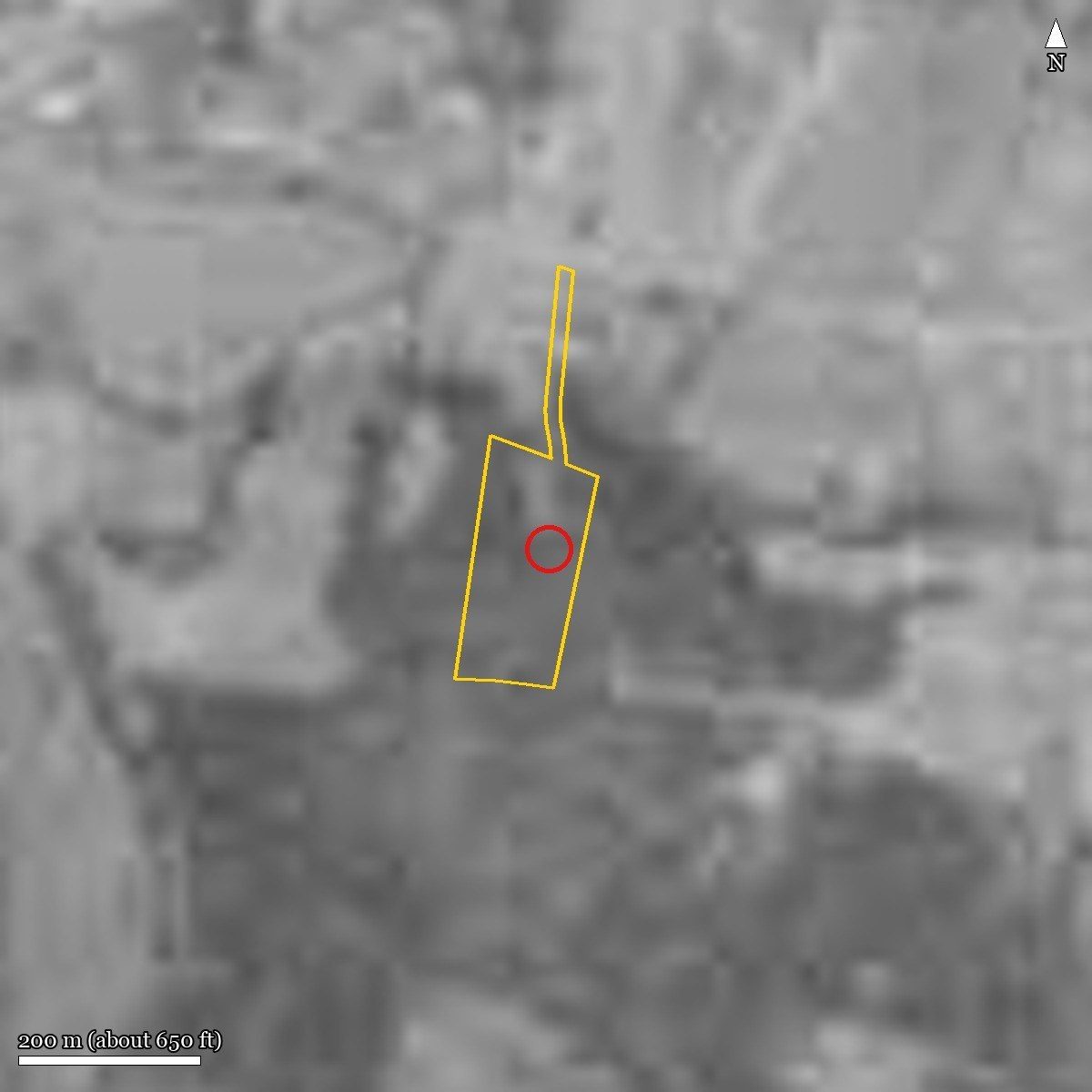
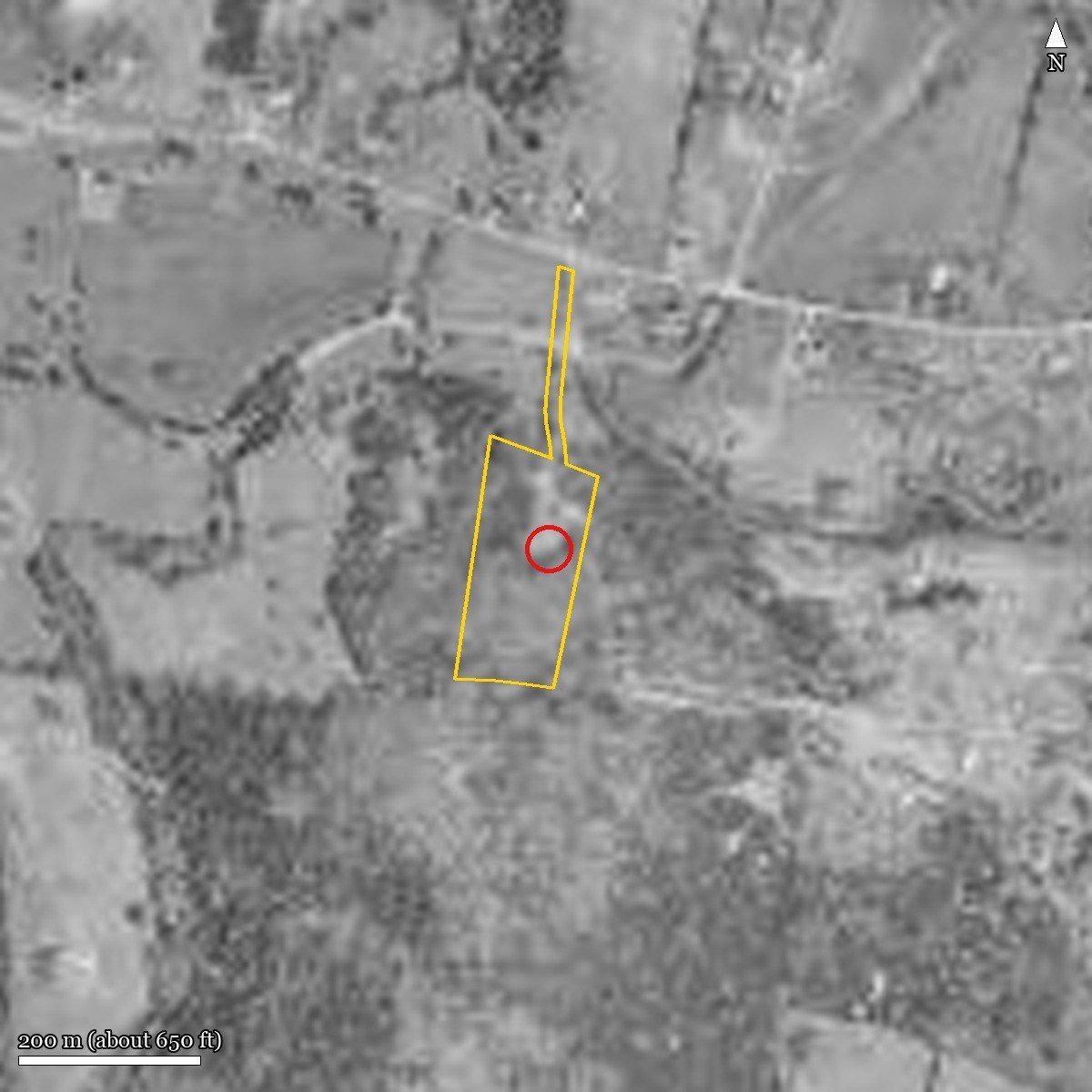
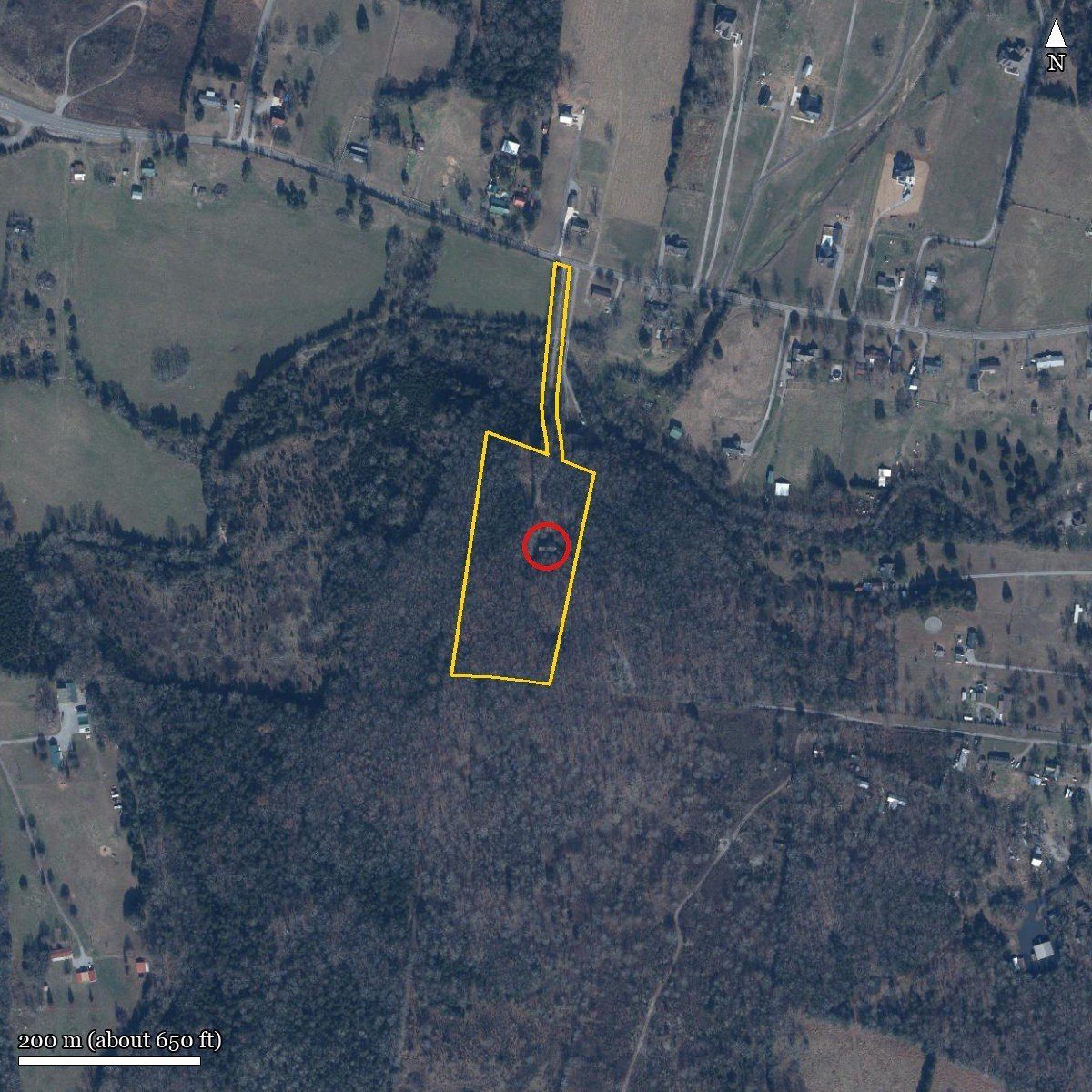
Drag the slider to watch the same spot from the air across seventy years. The yellow outline is Lot 8.
Every map and air photo from 1951 to 1997 shows the knoll in trees while the creek bottom below was farmed. The soil survey suggests why: the knoll is thin, rocky clay, only about two and a half feet deep over limestone, poor ground for crops. The survey also maps it as eroded, so it may have been cleared or grazed at some point before 1951. The deep, good soil lies on the flat beside Sinking Creek, which an 1879 history says runs into a sink south of Gladeville "where it disappears."
The nearest old family burying ground is the small Martin-Jenkins Cemetery, about a quarter mile north across the pike, where Linzy C. Martin (1793-1883) and his family lie. The Martins were probably the closest farm family to the knoll in the 1800s. Who owned the knoll itself isn't known yet; the old deeds would say.
Stewarts Ferry Pike
The road is named for Stewart's Ferry, a crossing of the Stones River on the way to Nashville. Congress approved a dam downstream in 1946, calling the project the "Stewarts Ferry Reservoir," renamed it for Congressman Percy Priest in 1958, and the finished lake covered the old crossing in 1967-68. In late 1862, before the Battle of Stones River, Union and Confederate troops skirmished "between Rural Hill and Gladeville, along what is now called Stewarts Ferry Pike," a state historical marker records.
1959: Stewarts Ferry Pike runs west from Gladeville to the ferry on the Stones River. USGS Nashville sheet, 1959.1984: Percy Priest Lake has covered the ferry crossing. USGS Nashville sheet, 1984.
The house Gary built
Lot 8: 8.07 acres of woods.
1988September 9: four empty lots, apparently cut from one farm, sell the same day. Lot 8 sells for $14,000.
1993October 8: Lot 8 sells again, still empty, for $29,500, most likely to Gary and Gloria Scott.
1997Gary builds the house, about 1,000 feet back from the road at the end of a long driveway.
2016-2024County tax bills read "Scott R Gary Etux Gloria W."
2023October: the family lists the house and the lot next door together.
2024March 19: the house sells for $570,000.
Lot 8 (yellow) and neighboring lots cut from the same farm (bold white). The thin strip at the top is the driveway out to Stewarts Ferry Pike. Wilson County parcel lines over Esri World Imagery.
Built
1997, by Gary Scott
Living space
2,213 sq ft, two stories
Floor area
1,020 sq ft down and 1,020 up, plus a 576 sq ft low-ceilinged upstairs room, likely over the two-car garage
Outside
Covered front porch, glassed-in sunroom, carport, shed
Inside
Wood-burning fireplace in the living room
Utilities
Its own well and septic tank, no city water or sewer
The front porch and steps. 2023 listing photo.The back of the house and the sunroom. 2023 listing photo.The living room and its fireplace. 2023 listing photo.Inside the sunroom, looking out into the woods. 2023 listing photo.
The 2023 drone photo, looking south, with both of Gary's lots outlined in green. Lot 8 and the house are on the right. 2023 listing photo (RealTracs MLS).
The side yard and swing set, from the fall 2023 listing. 2023 listing photo.September 6, 1943: Russell writes home from "the maneuver area - near Lebanon." Scott family wartime letters, scottclarke.org.
Fifty-four years before Gary built here, his father Russell wrote home from Army training: "I am in the maneuver area - near Lebanon... The country around here is similar to that around Knoxville. There may be a few more hills here."
The Scott line
Father to son, from Gary back to the Revolution. Tap a generation to open it, or use the interactive family tree above to see everyone together.
1Russell Gary Scottmarried Gloria WrightProven by records
Gary grew up in Chattanooga with his younger sister Nancy (1953-2001). He built the house on Stewarts Ferry Pike in 1997, and he and Gloria raised Abigail and Arthur there. Gary is also the family historian: he keeps the Scott-Clark(e) Family Association website, and he and Gloria typed up the 1969 family history in 1983.
Margaret with Nancy and Gary. Scott-Clark(e) Family Association collection.Gary, Alan, Nancy, Bobby and Carole in Chattanooga. Scott-Clark(e) Family Association collection.
Sources: His father's 2013 obituary; county tax records 2016-2024.
2Russell Julian ScottAugust 27, 1920 - May 26, 2013; married Margaret Grey Patching (1923-2000) in the fall of 1947Proven by records
Probably born at Huffman in Morgan County; grew up in Lancing; played football at Central High in Wartburg. In 1942 he kept count of the meals served at Fontana, N.C., where Fontana Dam was being built. By October he was in the Army at Camp Breckinridge, Ky.; a 1947 newspaper notice says he served four years with the Army Air Forces, and family records say he was a mechanic on Okinawa at the war's end. Tennessee Tech, then UT Knoxville in transportation. A career with the airlines, retiring from United in 1980. Margaret, the Oakdale grocer's daughter, was working for the Atomic Energy Commission at Oak Ridge when they became engaged in 1947; the wedding was set for September 26 at her parents' home. She later organized the Scott and Clark family reunions and loved family history.
Russell played football at Central High School in Wartburg in the late 1930s. Scott-Clark(e) Family Association collection.Russell in uniform at home in Lancing. Scott-Clark(e) Family Association collection.A "625th Bn. Shop" sign, from Russell's wartime photos. Scott-Clark(e) Family Association collection.Loading cargo onto a Vickers Viscount airliner. Scott-Clark(e) Family Association collection.September 6, 1943: Russell writes home from "the maneuver area - near Lebanon." Scott family wartime letters, scottclarke.org.April 1950 census: Russell J. Scott, 29, and Margaret P., 26, at 727 Dale Avenue, Apartment 2, Knoxville. 1950 U.S. Census, National Archives.
Sources: Obituaries (2000, 2013), 1947 engagement notice (Knoxville News-Sentinel), 1950 census, Margaret's Social Security record, gravestone, family letters.
3John Long ScottFebruary 10, 1882 - May 24, 1961; married Alta May Clark (1889-1979) in July 1910Proven by records
Born at Sunbright. Enlisted at Lancing at 19 and served three years in the 9th and 1st U.S. Infantry, rising to sergeant, including service in the Philippine Islands from December 1901 to April 1903. He worked for the railroad, and his daughters' letters place him at the Lancing depot from about 1920 into the 1940s. About 1950 a stroke left him partly disabled. A musical family: the children sang in quartets at church, and John sang with them.
"Grandpa Scott," John Long Scott, at Lancing in the 1950s. Scott-Clark(e) Family Association collection.The 1956 reunion of John and Alta Scott's family. Scott-Clark(e) Family Association collection.John L. Scott's 1904 Army discharge: service in the Philippine Islands, December 1901 to April 1903. Scott-Clark(e) Family Association collection.1950 census: John L. Scott's household at Lancing. 1950 U.S. Census, National Archives.John Long Scott at the grave of his parents, Zachary and Mary, Pleasant Ridge Cemetery. Scott-Clark(e) Family Association collection.
Sources: Army discharge and pension papers, Social Security index, 1950 census, gravestone, his own journal, his daughters' journal and letters, the 1969 family history, and a 1960 Knoxville News-Sentinel column (the stroke).
4Zachary Taylor ScottFebruary 28, 1849 - October 4, 1931; married Mary Patten Jones (1856-1937) in 1871Proven by records
Farmer and land surveyor, born near Sunbright. The family website says he bought the Huffman farm in 1901. In 1895 he wrote down his father's account of the family, and in 1929 he signed it as a statement. Much of what the family long knew about its Kentucky years came from that statement.
Zachary Taylor Scott. Scott-Clark(e) Family Association collection.Zachary Taylor Scott and his wife Mary "Polly" in front of their home (filed with the family's Huffman photos). Scott-Clark(e) Family Association collection.Zachary and Mary Scott's stone, Pleasant Ridge Cemetery. Find a Grave.
Sources: His own 1929 statement, his son's Social Security record, gravestone, the family website (the farm purchase), his granddaughter Jewell's journal.
5Russell Scott1808 - February 23, 1896; married Mary "Polly" Webb (died 1854)Proven by records
Born near Albany, Kentucky. Came to the Emory River, where Montgomery was laid out in 1826, as a boy in 1821 (family account). Thirteen children. At his death he left "12 children, 85 grandchildren, over 100 great-grandchildren." Buried in the Hall Cemetery near Sunbright.
Sources: His son's 1929 statement, his death notice (as copied in the 1969 family history), the 1887 county history, Find a Grave.
6Samuel ScottJune 19, 1777 - May 25, 1841; married Lydia LongProven by records
Born in Burke County, North Carolina. Family accounts say he farmed, ran a mill and made saltpeter on Spring Creek in Kentucky. Almost certainly the Samuel Scott who served as a sergeant in the War of 1812. One of the commissioners who founded the new county seat of Montgomery, Tennessee, where he kept a tavern; justice of the peace. Buried under a stone gravehouse in the Montgomery Cemetery. A son, Samuel Jr. (very likely the Samuel Scott of Linn County, Kansas), helped make Kansas's first laws in 1855, before it was a state, and was hanged by anti-slavery raiders in 1860.
"Ye Olde Tavern" at Montgomery, the log inn Samuel Scott kept until 1841, photographed while it was still lived in, probably by about World War I (date unknown). Old postcard as printed in the Morgan County News, 1960, via TNGenWeb.1813: "Samuel Scott, 3d Sergeant," Captain William Wood's company, Colonel Taul's Kentucky mounted volunteers. Kentucky Adjutant General, Soldiers of the War of 1812 (1891), via Internet Archive.1837: Samuel Scott, a justice of the peace, certifies that his parents married in 1775 in what became Burke County, and that he was born there June 19, 1777. Pension file W5997, transcribed by Will Graves, revwarapps.org.The 1883 History of the State of Kansas on Samuel Scott of Linn County (Samuel Jr. in the Tennessee family's papers). A. T. Andreas (W. G. Cutler), History of the State of Kansas, 1883, via Internet Archive.
Sources: His own signed statement (1837), the 1813 muster roll, the 1887 and 1987 Morgan County histories, the state historic survey of his gravehouse, and family accounts.
7Thomas ScottJuly 19, 1755 - March 1, 1834; married Lettice Russell in 1775Proven by records
Born in Maryland, raised in Wilkes County, North Carolina. Militia volunteer on the frontier "against the Indians" in 1777-78, then a horseman at the Battle of Kings Mountain on October 7, 1780, where he stayed to help care for the wounded. Died on the Kentucky-Tennessee line.
Thomas Scott's sworn 1833 statement for his Revolutionary War pension: born July 19, 1755 in Maryland; at the Battle of Kings Mountain. Pension file W5997, transcribed by Will Graves, revwarapps.org.
Sources: His sworn statement for his Revolutionary War pension (1833), with sworn statements from his son and a fellow soldier.
8Samuel Scott and Mary Jonesof Prince George's County, Maryland; married about 1751Likely
Copies of court papers, made by a Scott family historian, say Mary named "her son Thomas Scott" in Burke County in 1789; the originals haven't been found. Other records show the family group around them: in 1790 Mary Scott, Thomas, Richard and Nathan Scott and William Russell lived side by side in Wilkes County, and a 1793 paper in which Richard Scott put his sister in charge of his land business links him to his sister Jemima and brother Samuel Jr. Thomas named his first children Mary and Samuel. Likely, not proven. See Further back.
Sources: Jerry Scott's copies of 1788-89 sworn statements (originals not found); 1790 census of Wilkes County, N.C.; 1793 Wilkes County court records.
Two family stories: true or not?
"John Scott of Edinburgh." Some family trees made by other people put a John Scott, born about 1706 near Edinburgh, at the top of this line. The records show he belongs to a different Thomas Scott, born 1754 in Pennsylvania, who also fought at Kings Mountain and also died in Kentucky in 1834. Gary's Thomas was born in Maryland in 1755 and married Lettice Russell.
Culloden and General Winfield Scott. The 1969 family history tells of two brothers who fled Scotland after the Battle of Culloden in 1746, one the ancestor of this family and one of General Winfield Scott. The general's memoirs do say his grandfather escaped from Culloden. But no record links the families, and a family historian's copies of Maryland land records (the originals haven't been found) put this family's Scotts in Prince George's County by the 1720s, which would rule the story out. It stays a cherished family story.
Further back: every family line
Every family line, as far back as the records go, with the life behind each name. "Proven" means an original record states the relationship. "Likely" means the records point strongly to it, but none says it outright. "Not yet proven" means it rests on a copy of a record whose original hasn't been found, or on a family chart.
Gary's father's side: Russell J. Scott's ancestors as of October 2026. Solid boxes are proven by records, dashed are likely, dotted are not yet proven. Samuel Hall Sr. and Millian Webb appear once, with lines from both of their sons. Chart made from the records on this page.Gary's mother's side: Margaret Patching's ancestors as of October 2026. Solid boxes are proven by records, dashed are likely. Chart made from the records on this page.
The Scotts in Maryland, before 1755
Thomas Scott's parents are still likely, not proven: Samuel Scott, a millwright, and Mary Jones, daughter of Richard Jones of Anne Arundel County. The only papers that name them as Thomas's parents are copies of sworn statements from a 1788-89 court case, made by a Scott family historian; the originals haven't been found. Other records show the family moving and living together. In 1790 Mary Scott headed her own household in Wilkes County, N.C., listed beside Thomas, Richard and Nathan Scott and William Russell, the husband of Thomas's likely sister Rachel. In 1793 Richard Scott, about to leave for Tennessee, empowered "my well beloved Sister Jemima Scott" to take a deed for "Samuel Scott Junior my brother", with William Russell as witness. That same year Thomas bought 290 acres on Randolph's Creek of the Lower Little River.
Further back, the trail is not yet proven. A Thomas Scott was registered at birth in Queen Anne Parish in 1702 and died in 1739; his father was likely William Scott (about 1672-1752), who married Mary Lucas. Her father's 1721 will names "my Daughter Mary Scott ye Wife of William Scott". These Scotts held land on the upper Eastern Branch (the Anacostia) of the Potomac, in tobacco country that is now the Washington suburbs. Samuel built water mills, skilled work every neighborhood needed. About 1774-75 Mary took the children to the Carolina backcountry, and they settled on the Lower Little River, now Alexander County, N.C.
1702Thomas Scott registered at birth in Queen Anne Parish, Maryland (possibly an ancestor).
1721Thomas Lucas's will names his daughter Mary, wife of William Scott.
about 1751Samuel Scott marries Mary Jones (from a copy of a sworn statement he made in 1788).
1755Thomas Scott born in Maryland, July 19.
1766-68Samuel Scott, millwright, sells the family tracts "The Girls Portion", "Dan" and "William and Mary Increased".
about 1774-75Mary Scott, her children and William Russell move to the North Carolina backcountry.
1790Mary, Thomas, Richard and Nathan Scott and William Russell side by side in the Wilkes County census.
1793Thomas buys 290 acres on Randolph's Creek; Richard Scott's paper putting his sister in charge of his land business names her, Jemima, and his brother Samuel Jr.
1721: Thomas Lucas's will, Prince George's County, Maryland, leaves a shilling to "my Daughter Mary Scott ye Wife of William Scott". Maryland Prerogative Court wills, via FamilySearch.1790 census, Wilkes County, N.C.: "Thom Scott", "Rd Scott", "Mary Scott" and "Wm Russell" listed on the same page, with Nathan Scott in the next column. U.S. Census 1790, via FamilySearch.1793: Richard Scott empowers "my well beloved Sister Jemima Scott" to take a deed for "Samuel Scott Junior my brother". Witness: William Russell. Wilkes County, N.C. court records, via FamilySearch.
The Longs and Julians: Lydia Long Scott's family
Lydia's father Edward Long is proven: her sister's husband, Capt. Isaac Story, swore in 1844 that he and Samuel Scott "married sisters the daughters of Edward Long". Edward farmed on the Burke-Wilkes border, sat on a Burke County grand jury in 1795 and bought 150 acres on Kings Creek in 1804. By 1810 he was in Cumberland County, Kentucky, next door to Solomon Long and near Samuel and Thomas Scott: the Longs, Scotts and Storys moved west as one group. Lydia's sister Abigail married Isaac Story in 1800.
Lydia's mother was very likely Catherine Julian, of a French Protestant family that lived in Cecil County, Maryland, near Winchester, Virginia, and finally on the Deep River in Randolph County, N.C. Her parents were likely Isaac Julian (about 1716-1778) and Barbara White; family accounts say a rattlesnake bite killed Isaac in July 1778. The family chart's "Soloman Edward Long" and "Gabriel Tobias Long" are not supported by any record.
Lettice Russell, Thomas Scott's wife: no record names her parents. A family chart names Joseph Russell and Elizabeth Penn, but no record backs it up.
1800: the paper Isaac Storie signed to get a license to marry Abigal Long, Lydia Long's sister, in Wilkes County, N.C. North Carolina marriage bonds, via FamilySearch.
The Webbs and Halls: Polly Webb Scott's family
Russell Scott's wife was called "Polly" in the records ("Nancy" was her mother's name). Her parents are now proven. Her father John Webb Sr. made his will on July 30, 1841, leaving his Emory River land to "my three daughter Polly and Rhoda and Hopy Webb"; in 1857 Polly's daughter Lydia sold land "Willed by him to his three daughters Polly Scott ... Polly Scott being my Mother". John died in 1841, not 1848 as the cemetery marker says. Her mother Nancy Hall (1787-1857) married John Webb in Roane County on August 4, 1809; her father signed the marriage papers with him.
Nancy's father was Martin Hall (proven): in 1846 she sold her son-in-law Russell Scott her share of the land of "Martin Hall the father of the said Nancy Webb". Martin was one of the first settlers on the Emory River: in September 1807 he claimed 89 acres "at the forks of Emery River including the Improvement where the said Hall now lives", and his brother Samuel took the next tract. The Halls came from Pittsylvania County, Virginia, by way of Wilkes County, N.C. Martin's parents were likely Samuel Hall Sr. and Millian Webb; a 1774 deed in which her father gave her property names "my Daughter Millian Hall wife of Samuel Hall". Samuel Hall Sr.'s sons served in the Wilkes militia under Colonel Benjamin Cleveland during the Revolution, the same commander as Thomas Scott at Kings Mountain.
1774Merry Webb Sr. gives a gift to "my Daughter Millian Hall wife of Samuel Hall", Pittsylvania County, Va.
about 1775-79The Halls move to Wilkes County, N.C.
1807Martin Hall and his brother Samuel settle at the forks of the Emory River.
1809John Webb marries Nancy Hall, Roane County.
1830-34Martin Hall dies, leaving a will and eight heirs.
1841John Webb Sr.'s will names daughters Polly, Rhoda and Hopy.
1846Nancy Webb sells Russell Scott her share of her father Martin Hall's land.
1857Lydia Scott Hall: "Polly Scott being my Mother".
July 30, 1841: John Webb Sr.'s will leaves his Emory River land to "my three daughter Polly and Rhoda and Hopy Webb" and names his share of "the Estate of Martin Hall deceased". Morgan County, Tenn. deed book M (recorded copy), via FamilySearch.1846: Nancy Webb, widow of John Webb, sells Russell Scott her share of the land of "Martin Hall the father of the said Nancy Webb". Morgan County, Tenn. deeds, via FamilySearch.August 4, 1809: the paper John Webb signed to get a license to marry Nancy Hall, Roane County, Tennessee. Her father, Martin Hall, signed it with him. Tennessee county marriages (1930s copy of the original), via FamilySearch.1857: Lydia Scott Hall, Russell Scott's daughter, sells land "Willed by [John Webb Sr.] to his three daughters Polly Scott ... Polly Scott being my Mother". Morgan County, Tenn. deed book M, via FamilySearch.
The Joneses and Halls: Polly Jones Scott's family
Zachary Scott's wife Mary "Polly" Jones (1856-1937) was the daughter of William Hazen Jones (1821-1912) and Elizabeth Hall (proven by the 1929 family statement and every census; her 1937 death certificate says "Mary Hall", a mistake by the son who gave the details). William was born in Kingston, Roane County. As a teenager he served as a musician in a Tennessee mounted infantry company during the 1836-38 Cherokee removal, the Trail of Tears, and drew a pension for it in old age. He was a blacksmith at Kingston in 1850 and at the county seat of Montgomery in 1860, later called himself a retired merchant, and died at Sunbright aged 91.
Elizabeth's father was Garrett Hall (1785-1862) and her mother Telitha C. Davidson (proven). Garrett served in the War of 1812 as a lieutenant, then captain, of Tennessee militia (the family statement's "Revolutionary War" belongs to his father). When Morgan County was organized he became its first sheriff (1818-1820) and served again in 1840-42; in 1820 he ran a distillery. He is buried in the Hall Cemetery at Sunbright. His father was likely Samuel Hall Jr. (1760-1819), a Revolutionary soldier in the Wilkes militia.
War of 1812 pension card: Garrett Hall, Tennessee militia; widow Telitha C., married March 8, 1811. War of 1812 pension index, National Archives, via FamilySearch.Indian Wars pension card: William H. Jones, musician, Capt. Hembree's company, 2nd Tennessee Mounted Infantry (Cherokee War); widow Lucretia, 1912. Indian Wars pension index, National Archives, via FamilySearch.1937: Mary "Polly" Jones Scott's death certificate, Lancing. It names her father William Jones; "Mary Hall" for her mother is a mistake by the son who gave the details (her mother was Elizabeth Hall). Tennessee death certificates, via FamilySearch.
Zachary and Polly were very likely third cousins. A sworn 1840 statement in Samuel Hall Jr.'s Revolutionary War pension papers says the widows of Martin Hall and Samuel Hall Jr. were sisters "and their husbands brothers". Zachary descends from Martin Hall (through Nancy Hall Webb and Polly Webb); Polly Jones descends from Samuel Hall Jr. (through Garrett Hall and Elizabeth Hall). Their shared ancestors were Samuel Hall Sr. and Millian Webb of Pittsylvania County, Virginia. The weakest link is Garrett as Samuel Jr.'s son: it rests on a later copy of those pension papers, which lists Letitia Hall's children.
The Clarks, Carpenters and Saunders: Alta Clark Scott's family
Rev. Jason S. Clark's 1928 death certificate names his parents, Amasa Clark and Roxalana Carpenter (proven). A 1935 family memoir says Amasa worked other men's farms around Rutland, Vermont, cutting grain with a sickle, then in 1850 brought the family west by Erie Canal boat; the 1860 census finds them in Berlin Township, St. Clair County, Michigan, and in 1880 they farmed near Yale in Sanilac County. Roxalana's parents were likely Samuel Carpenter and Roxy Newton of Ira, Vermont; her grandfather may have been Elder Joseph Carpenter, Ira's Baptist pastor (possible).
Jason enlisted in Company G of the 10th Michigan Infantry, in 1861. Fever after the Corinth campaign put him in the military hospital at Camp Dennison, Ohio ("Disease and the doctors kill more in an army than the rebels"); he was back standing guard at Nashville by December 1862, and the regiment went on with Sherman. He married Jerusha Saunders at Lakeport, Michigan in 1866. Her father John Saunders, born in Ireland (County Carlow, his obituary says), was a brickmaker in Pennsylvania in 1850 and later farmed near Yale; her mother was Margaret Castor (both proven). The family says Jason came to Tennessee in 1884 for his wife's health and the climate he remembered from the war.
1928: Rev. Jason S. Clark's death certificate, Lancing: minister, born in Vermont, father Amasa Clark, mother Roxalana Carpenter. Tennessee death certificates, via FamilySearch.February 22, 1866: Jason S. Clark, 24, and Jerusha C. Saunders, 17, married at Lakeport, Michigan. Michigan marriages, via FamilySearch.
The Patchings, Wakefords and Smithers: Walter Patching's family
George Patching was born on August 21, 1845 in Worthing, Sussex, England, and baptized at Broadwater church on October 5; his father James was a baker. Four generations were baptized, married and buried at Broadwater between 1764 and 1855: James (baptized 1812), his parents William Patching (baptized 1766) and Charlotte Cunningham, married there in 1798, and William's likely father John (buried 1790). James's wife Maria was very likely the Maria baptized at Broadwater in 1811, daughter of Thomas Wakeford, a bricklayer from Lancing, Sussex (the same name as the Tennessee town where the Scotts later lived, a coincidence as far as the records show). The parish and the family's birth date match, but no record ties the two Marias together yet.
The family left for Canada between February 1848 and late 1849, not in 1847, and by 1861 farmed in McGillivray Township, north of London, Ontario. George married Isabella Smithers, daughter of William Smithers and Elizabeth Cook, at Carlisle, Ontario in 1870, moved to Michigan, and was in Morgan County, Tennessee by 1877, before the Rugby colony was founded. What brought him is still unknown.
October 5, 1845: George, son of James and Maria Patching of Worthing, baker, baptized at Broadwater church (born August 21). Broadwater, Sussex parish register, via FamilySearch.May 30, 1798: William Patching and Charlotte Cunningham married at Broadwater church, Sussex. Broadwater, Sussex parish register, via FamilySearch.
The Waddells and Paines: Stella Waddell Patching's family
Stella's parents were Daniel Heath Waddell and Sarah Willanna Paine, married on September 26, 1883 in Lawrence County, Ohio, by the groom's father, Rev. Daniel Waddell, a Methodist preacher turned fruit grower. (Stella's Social Security records misspell her mother's name as "Williams Paine".) Willanna was born at Ashland, Kentucky, the daughter of Dr. William V. Paine and Sarah Haskell. Widowed, Sarah married Alanson Gillett, whose seedling became the Rome Beauty apple, and they moved to Harriman. Heath and Willanna followed to Lancing about 1888-90, where Stella was born in 1890. Willanna died at Lancing of typhoid in 1918; Stella, then 28, signed her death certificate.
September 26, 1883: Daniel H. Waddell and Willanna Paine married in Lawrence County, Ohio, by the groom's father, Rev. D. Waddell. Ohio county marriages, via FamilySearch.1918: Willanna Waddell's death certificate, Lancing, signed by her daughter Stella. Born Ashland, Ky.; father Dr. Paine; mother Sarah Haskell. Tennessee death certificates, via FamilySearch.
How sure is each link? "Proven" means an original record states it: a will, a deed, a marriage license, a church register, a census sheet, a pension card or a death certificate. Family charts and other people's family trees were treated only as clues. Where they disagree with the records, the records win, and several chart details are corrected above.
The records
Every original record and photo behind this story. Tap any one to see it large.
Thomas Scott's sworn 1833 statement for his Revolutionary War pension: born July 19, 1755 in Maryland; at the Battle of Kings Mountain. Pension file W5997, transcribed by Will Graves, revwarapps.org.1837: Samuel Scott, a justice of the peace, certifies that his parents married in 1775 in what became Burke County, and that he was born there June 19, 1777. Pension file W5997, transcribed by Will Graves, revwarapps.org.1813: "Samuel Scott, 3d Sergeant," Captain William Wood's company, Colonel Taul's Kentucky mounted volunteers. Kentucky Adjutant General, Soldiers of the War of 1812 (1891), via Internet Archive.The Morgan County history on Samuel Scott, Montgomery and the tavern. Dickinson, Morgan County (1987), p. 12.The 1883 History of the State of Kansas on Samuel Scott of Linn County (Samuel Jr. in the Tennessee family's papers). A. T. Andreas (W. G. Cutler), History of the State of Kansas, 1883, via Internet Archive.John L. Scott's 1904 Army discharge: service in the Philippine Islands, December 1901 to April 1903. Scott-Clark(e) Family Association collection.1950 census: John L. Scott's household at Lancing. 1950 U.S. Census, National Archives.1950 census: Walter Patching, 59, retail grocery merchant in his own business. The household's street is Highway 27, just outside Oakdale town. The census does not say where the store was. 1950 U.S. Census, National Archives.April 1950 census: Russell J. Scott, 29, and Margaret P., 26, at 727 Dale Avenue, Apartment 2, Knoxville. 1950 U.S. Census, National Archives.January 1947: a letter to Russell at 809 Arnold Avenue, Cookeville, while he was at Tennessee Tech. Scott family wartime letters, scottclarke.org.July 31, 1947: Margaret Grey Patching's engagement to Russell J. Scott. She was with the Atomic Energy Commission at Oak Ridge; he had served four years with the Army Air Forces; the wedding would be in the fall at her parents' home. Knoxville News-Sentinel, July 31, 1947, p. 14, via Newspapers.com.Undated note, filed by the family as August 1947: brother Bill accepts the invitation to be best man "at your wedding on September 26th." Scott family letters, scottclarke.org.February 13, 1960: Mrs. J. L. Scott of Lancing writes to the "Strolling" columnist: "My husband is a semi-invalid from a stroke about 10 years ago." Knoxville News-Sentinel, February 13, 1960, p. 12, via Newspapers.com.1721: Thomas Lucas's will, Prince George's County, Maryland, leaves a shilling to "my Daughter Mary Scott ye Wife of William Scott". Maryland Prerogative Court wills, via FamilySearch.1790 census, Wilkes County, N.C.: "Thom Scott", "Rd Scott", "Mary Scott" and "Wm Russell" listed on the same page, with Nathan Scott in the next column. U.S. Census 1790, via FamilySearch.1793: Richard Scott empowers "my well beloved Sister Jemima Scott" to take a deed for "Samuel Scott Junior my brother". Witness: William Russell. Wilkes County, N.C. court records, via FamilySearch.1800: the paper Isaac Storie signed to get a license to marry Abigal Long, Lydia Long's sister, in Wilkes County, N.C. North Carolina marriage bonds, via FamilySearch.August 4, 1809: the paper John Webb signed to get a license to marry Nancy Hall, Roane County, Tennessee. Her father, Martin Hall, signed it with him. Tennessee county marriages (1930s copy of the original), via FamilySearch.July 30, 1841: John Webb Sr.'s will leaves his Emory River land to "my three daughter Polly and Rhoda and Hopy Webb" and names his share of "the Estate of Martin Hall deceased". Morgan County, Tenn. deed book M (recorded copy), via FamilySearch.1846: Nancy Webb, widow of John Webb, sells Russell Scott her share of the land of "Martin Hall the father of the said Nancy Webb". Morgan County, Tenn. deeds, via FamilySearch.1857: Lydia Scott Hall, Russell Scott's daughter, sells land "Willed by [John Webb Sr.] to his three daughters Polly Scott ... Polly Scott being my Mother". Morgan County, Tenn. deed book M, via FamilySearch.War of 1812 pension card: Garrett Hall, Tennessee militia; widow Telitha C., married March 8, 1811. War of 1812 pension index, National Archives, via FamilySearch.Indian Wars pension card: William H. Jones, musician, Capt. Hembree's company, 2nd Tennessee Mounted Infantry (Cherokee War); widow Lucretia, 1912. Indian Wars pension index, National Archives, via FamilySearch.1937: Mary "Polly" Jones Scott's death certificate, Lancing. It names her father William Jones; "Mary Hall" for her mother is a mistake by the son who gave the details (her mother was Elizabeth Hall). Tennessee death certificates, via FamilySearch.1928: Rev. Jason S. Clark's death certificate, Lancing: minister, born in Vermont, father Amasa Clark, mother Roxalana Carpenter. Tennessee death certificates, via FamilySearch.February 22, 1866: Jason S. Clark, 24, and Jerusha C. Saunders, 17, married at Lakeport, Michigan. Michigan marriages, via FamilySearch.October 5, 1845: George, son of James and Maria Patching of Worthing, baker, baptized at Broadwater church (born August 21). Broadwater, Sussex parish register, via FamilySearch.May 30, 1798: William Patching and Charlotte Cunningham married at Broadwater church, Sussex. Broadwater, Sussex parish register, via FamilySearch.September 26, 1883: Daniel H. Waddell and Willanna Paine married in Lawrence County, Ohio, by the groom's father, Rev. D. Waddell. Ohio county marriages, via FamilySearch.1918: Willanna Waddell's death certificate, Lancing, signed by her daughter Stella. Born Ashland, Ky.; father Dr. Paine; mother Sarah Haskell. Tennessee death certificates, via FamilySearch.1949: a letter from Russell at 727 Dale Avenue, Knoxville. Scott family letters, scottclarke.org.September 6, 1943: Russell writes home from "the maneuver area - near Lebanon." Scott family wartime letters, scottclarke.org.Zachary and Mary Scott's stone, Pleasant Ridge Cemetery. Find a Grave.John Long Scott at the grave of his parents, Zachary and Mary, Pleasant Ridge Cemetery. Scott-Clark(e) Family Association collection.Russell and Margaret's stone, Morgan Memorial Gardens, Wartburg. Find a Grave.An 1839 map of the country between the Albany (Paoli) area of Kentucky and Montgomery, Tennessee. The family says they made this move in 1821. David Burr map, 1839, Library of Congress.Montgomery on "Emery's River," Morgan County, on an 1832 map of Tennessee. Matthew Rhea map, 1832, Library of Congress.Queen Anne Parish around Leeland on an 1899 map. Copies of the old deeds, made by a Scott family historian, put the family's own land farther west, on branches of the Anacostia River; they have not been mapped. USGS Patuxent sheet, 1899.Burke County, N.C.: Fort Crider at Lenoir, Silver Creek and the Catawba River, the ground Thomas Scott served over in 1777-78. USGS Morganton sheet, 1905.Albany, Spring Creek and the Kentucky-Tennessee line. Blue marks roughly where Spring Creek runs "about three miles from Albany," near where the family says Samuel had his farm and mill (exact site unknown). USGS Byrdstown sheet, 1929.Montgomery on the Emory River, about a mile from Wartburg. Red: Samuel Scott's grave. Blue: the approximate site of the town of Montgomery, county seat 1826-1870. USGS Camp Austin quadrangle, 1935.Up the Emory from Montgomery: Gobey, built on the W. J. Scott place according to the family, and the Elizabeth Cemetery, where the family says Mary Webb Scott was buried in 1854 (her grave is unmarked). USGS Gobey quadrangle, 1935.Huffman Switch and the little valley of Scott Branch, where the railroad fill crosses. Going by the family's descriptions, this is probably the area of the Scott farm (about 1901-1925). USGS Rugby quadrangle, 1952.Lancing in 1952, with the approximate area of John and Alta Scott's house (from family photos) near the Presbyterian church. USGS Lancing quadrangle, 1952.Sunbright and the Hall Cemetery, where Russell Scott (1808-1896) is buried. USGS Pilot Mountain quadrangle, 1935.1956 government survey map. Green is woods. The red circle is the house site: a wooded knoll with Sinking Creek at its foot and fields on the creek side. USGS Gladeville quadrangle, 1956.Lot 8 (yellow) and neighboring lots cut from the same farm (bold white). The thin strip at the top is the driveway out to Stewarts Ferry Pike. Wilson County parcel lines over Esri World Imagery.
What's still unknown
Who owned the farm before 1988, and who bought Lot 8 in 1993. The 1988 and 1993 deeds, and the older deed for the farm the lots were cut from, are at the Wilson County Register of Deeds in Lebanon. Deed Book 411, page 550; Book 433, page 489; Book 262, page 209.
The Chattanooga house where Gary grew up. Margaret was active at Brainerd United Methodist, so it was likely in the Brainerd area. The old Chattanooga city directories at the Chattanooga Public Library's local history room would give the street address.
Russell Julian Scott's birthplace. Family papers place the family at Huffman at the 1920 census, but his sister Jewell wondered whether he was born in the Hixon House in Lancing that August. His birth certificate would settle it.
The exact Huffman farm. The 1901 deed from the Freels heirs would fix its boundaries. Morgan County's courthouse burned in 1904, so it may survive only as a later copy.
John Long Scott's accident with a mail crane. The family remembers that John was struck by a trackside mail crane (the post where mail sacks hung for passing trains) and lay unconscious for two or three days before he recovered. No newspaper story has been found: the Morgan County News survives in easy reach only for about 1917 to 1922. He also had a disabling stroke about 1950, and the family isn't sure whether the two are separate events. The paper's other years survive only on film at the Tennessee State Library and Archives in Nashville.
Martin Hall's will. Deeds of 1836 and 1846 cite it; it would name all eight heirs and his wife. Morgan County will books and court minutes, 1830-35, at the Morgan County Courthouse in Wartburg or on film at the Tennessee State Library and Archives in Nashville.
Lettice Russell's parents. No record names them. Wilkes County, N.C. deeds 1778-1800 and William Russell's estate in Carter County, Tenn. (about 1820) are the places to look.
Why George Patching came to Tennessee by 1877. Morgan County deed and court records of the 1870s.
Thomas Scott's parents. Samuel Scott and Mary Jones are likely (see Further back). The original sworn statements from the 1788-89 court case would prove it. They should be among the old Burke County court papers at the State Archives of North Carolina in Raleigh.